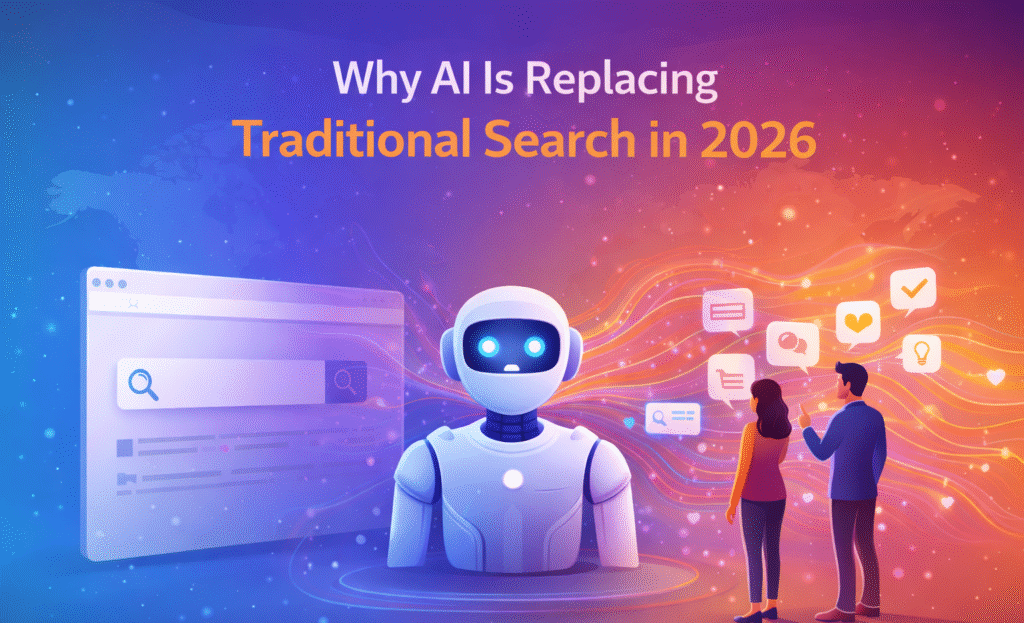
Search has long been the foundation of how users discover information, products, and services online. For years, businesses relied on traditional search engines and keyword-based optimization to stay visible. However, the rapid rise of artificial intelligence is fundamentally transforming this model. AI-powered search systems now understand context, intent, and behavior rather than simply matching keywords.
This shift is not just a technological upgrade; it represents a complete change in how businesses connect with their audiences. AI-driven search delivers instant, personalized answers, often without requiring users to click through multiple websites. While this creates incredible opportunities, it also introduces new challenges that businesses must address to remain competitive.
The Evolution from Traditional Search to Google Search to AI-Powered Search
Traditional search engines, including Google Search, were built around indexing web pages and ranking them based on keywords, backlinks, and metadata. Google refined this model with its sophisticated algorithms, delivering highly relevant results within seconds. AI-powered search, however, goes beyond page ranking and functions more like a digital assistant. It analyzes user intent, previous behavior, location, and conversational context to provide the most accurate and useful response.
With advancements in natural language processing and machine learning, AI understands complex questions, incomplete phrases, and conversational queries. Users no longer type in fragmented keywords; they ask full questions and expect immediate, precise answers. This shift is transforming how content is discovered, evaluated, and surfaced.
As a result, search is evolving from being primarily about page rankings to emphasizing relevance, authority, and user experience, bridging the gap between traditional search engines like Google and next-generation AI Search tools.
Does AI Replacing Search Create Problems for Businesses?
Yes, AI-Driven search does introduce several challenges, especially for businesses that continue to rely solely on traditional SEO strategies.
One of the most pressing issues is reduced organic visibility. AI-powered search engines and assistants often provide direct answers rather than directing users to websites. This means fewer clicks, lower traffic, and less exposure for businesses whose content is not optimized for AI interpretation. Even well-ranked pages can lose visibility if they fail to clearly address user intent.
Another challenge is the loss of control over brand messaging. AI systems summarize and interpret content dynamically, pulling insights from multiple sources. If a business’s content is vague, outdated, or poorly structured, AI may misrepresent it or ignore it altogether.
This can weaken brand authority and create inconsistency in how a business is perceived.
Navigating the Risks and Complexities of AI-Powered Search
Data privacy and trust also become critical concerns. AI relies heavily on user data to personalize results. Businesses that fail to manage data responsibly risk losing user trust and facing compliance issues. In an AI-first environment, transparency and ethical data usage are no longer optional, they are essential.
Additionally, competition becomes more intense. AI raises the standard for content quality. Generic blogs, shallow explanations, and repetitive marketing language are filtered out in favor of in-depth, experience-driven, and authoritative content. Businesses that do not invest in originality and expertise struggle to compete.
Finally, the technical complexity of AI adoption can be overwhelming. Implementing structured data, AI analytics, automation, and cloud-ready systems requires expertise and strategic planning. For many organizations, especially growing businesses, this transition can feel daunting without the right guidance.
Turning Challenges into Opportunities with AI
Despite these challenges, AI replacing traditional search is not a threat, it is an opportunity for businesses willing to adapt. The first step is shifting the focus from keyword-based optimization to intent-driven content. Businesses need to create content that genuinely answers questions, solves problems, and provides clarity. AI rewards depth, accuracy, and usefulness, making high-quality content more valuable than ever.
Structuring content so AI can easily interpret it is equally important. Clear headings, logical flow, semantic relevance, and properly formatted data ensure that a business’s message remains consistent, even when summarized by AI tools. Diversifying digital presence is another essential strategy.
Relying solely on search traffic is no longer sustainable. Strong branding, direct customer engagement, email communication, and personalized user experiences help businesses maintain visibility regardless of changes in search behavior.
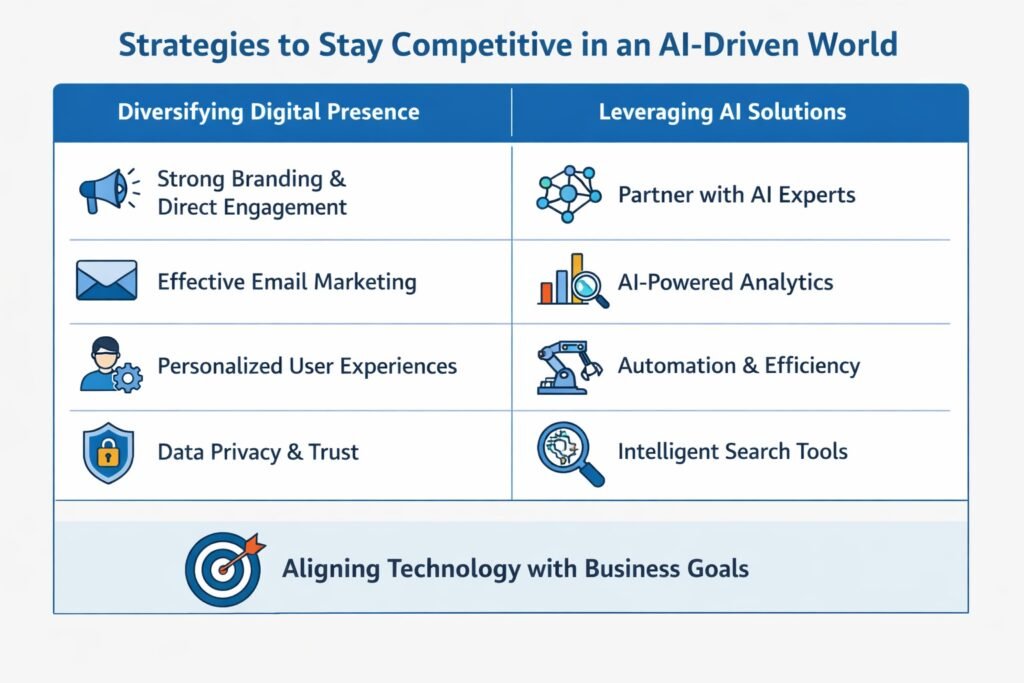
Strategies to Stay Competitive in an AI-Driven World
Diversifying digital presence is essential, as relying solely on search traffic is no longer sustainable. Strong branding, direct customer engagement, email communication, and personalized user experiences help businesses maintain visibility regardless of changes in search behavior. Privacy challenges can be managed through transparent data practices and secure systems, building trust as a powerful competitive advantage in an AI-first ecosystem.
From a technical standpoint, partnering with AI-focused solution providers like JetBoosters simplifies adoption, integrating AI-powered analytics, automation, and intelligent search solutions efficiently. This ensures businesses implement AI strategically, aligning advanced technology with real business goals
How JetBoosters Helps Businesses Stay Ahead
JetBoosters helps enterprises stay ahead in the AI-driven search and discovery landscape by architecting intelligent systems that align with how modern AI engines interpret, rank, and surface information. We leverage advanced data pipelines, behavioral analytics, and machine-learning models to extract actionable insights from user interactions across search, content, and digital touchpoints. This enables organizations to understand intent at scale, optimize for AI-generated responses, and continuously adapt to evolving algorithmic signals rather than relying on static SEO or legacy analytics frameworks.
Our services include the design and deployment of custom AI solutions that integrate seamlessly into existing SaaS ecosystems. This includes AI-powered search optimization, semantic content intelligence, predictive analytics, recommendation engines, and automation workflows that reduce manual intervention while increasing accuracy and speed. Each solution is built with modularity and interoperability in mind, allowing enterprises to operationalize AI across marketing, product, and customer experience functions while maintaining governance, explainability, and performance standards.
JetBoosters also delivers cloud-native, scalable infrastructure engineered for long-term resilience and growth. Using modern architectures, we enable businesses to deploy, monitor, and evolve AI workloads with high availability, security, and cost efficiency. Our systems support real-time personalization, dynamic content orchestration, and continuous optimization empowering organizations to move from reactive adaptation to proactive leadership in AI-first digital ecosystems.
Turning AI Search into a Competitive Advantage
AI is not eliminating search, it is redefining it. Businesses that cling to outdated strategies risk losing visibility, relevance, and trust. However, those that adapt by embracing AI-driven content, ethical data practices, and intelligent automation gain a powerful competitive edge.
The future of search belongs to businesses that prioritize relevance, experience, and innovation. With JetBoosters as your AI partner, you can confidently navigate this shift and turn AI-powered search into a catalyst for long-term growth and success.
Ready to future-proof your business in the age of AI? Get a Free Consultation at JetBoosters today to explore AI-driven solutions that boost growth and efficiency.