
Building a Minimum Viable Product has always been a strategic decision, but in 2026, it has become a financial and technological balancing act. With AI integration, cloud-native architectures, rising user expectations, and faster go-to-market pressure, businesses often ask a crucial question before starting: how much does it really cost to build an MVP today?
At JetBoosters, a tech and digital solution company helping startups and enterprises turn ideas into scalable products, we see this question daily. The short answer is that MVP costs vary widely. The real answer lies in understanding what you are building, why you are building it, and how strategically you approach development.
This article breaks down MVP development costs in 2026, explains where the money actually goes, provides realistic calculations, and answers the most common questions founders and product leaders ask before investing.
Understanding MVP Development in 2026
An MVP in 2026 is no longer a “basic” product in the traditional sense. Users now expect smooth performance, intuitive UI, strong security, and some level of intelligence, even in early-stage products. Whether you are launching a SaaS platform, a mobile app, or an AI-powered solution, your MVP must solve a real problem while being technically future-ready.
Modern MVP development combines lean product strategy with scalable engineering. This is why custom MVP development has replaced generic templates as the preferred approach for serious businesses.
The Core Factors That Define MVP Cost
The cost of building an MVP in 2026 depends on several interconnected factors. Product complexity plays the biggest role. A simple internal tool or validation app costs far less than a multi-role SaaS platform with AI features and third-party integrations.
Technology stack decisions also impact cost significantly. Products built with cloud-native infrastructure, modern frontend frameworks, and AI APIs require skilled teams, but they also reduce long-term operational expenses. This is where partnering with an experienced digital transformation company like JetBoosters makes a measurable difference.
Design expectations have also evolved. MVP users expect clean UX, responsive layouts, and accessibility by default. While overdesign is unnecessary, underdesign is no longer acceptable.
Finally, development team structure affects cost. Hiring freelancers may look cheaper upfront, but coordinated product teams with developers, designers, QA engineers, and product strategists often deliver faster and more reliably.
MVP Cost Breakdown: A Realistic Calculation for 2026
To understand actual costs, let’s look at a practical MVP scenario in 2026.
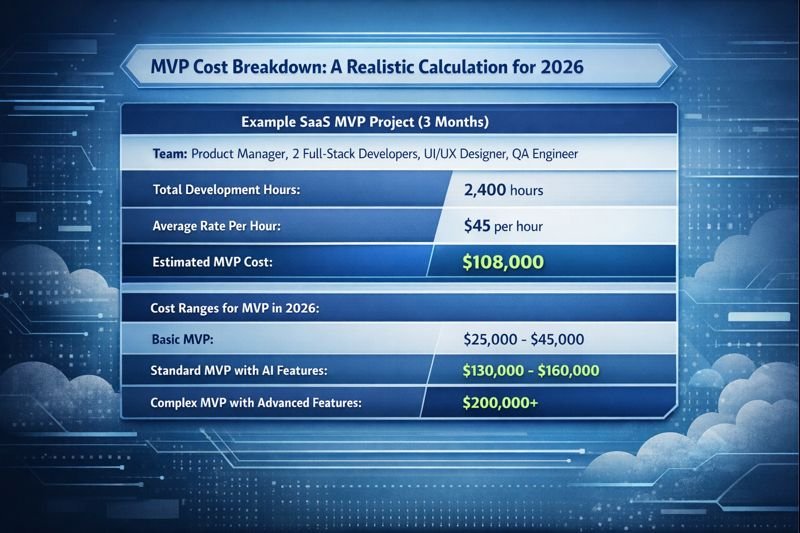
Assume you are building a SaaS MVP with user authentication, a dashboard, core business logic, basic AI-assisted features, and cloud deployment. The development timeline is around three months.
A typical MVP team includes one product manager, two full-stack developers, one UI/UX designer, and one QA engineer. In 2026, the average blended hourly rate for a skilled offshore or hybrid team ranges between $35 and $60, depending on expertise.
If the team works an average of 160 hours per month for three months, the total development hours come to approximately 2,400 hours.
At a conservative average rate of $45 per hour, the calculation looks like this:
2,400 hours × $45 = $108,000
This estimate includes product planning, UI/UX design, frontend and backend development, QA testing, and initial deployment. If AI integrations, advanced analytics, or enterprise-level security are added, costs can increase to around $130,000 to $160,000.
On the lower end, a simpler MVP with limited features and no AI components may cost between $25,000 and $45,000. On the higher end, complex MVPs with AI-driven personalization or real-time data processing can exceed $200,000.
Hidden Costs Founders Often Overlook
Many businesses underestimate MVP cost by focusing only on development. In reality, additional expenses often arise after launch. Cloud infrastructure, third-party APIs, AI usage costs, maintenance, and iterative improvements based on user feedback all require budget allocation.
This is why lean MVP development is not about spending less, but about spending smarter. At JetBoosters, we design MVPs to minimize rework, reduce technical debt, and scale without rebuilding from scratch.
MVP Cost vs Long-Term Value
One of the biggest mistakes founders make is trying to build the cheapest MVP possible. In 2026, speed and scalability matter more than minimalism alone. A well-architected MVP shortens the path to product-market fit, attracts investors faster, and reduces future redevelopment costs.
Investing in a solid foundation through product engineering services ensures that your MVP evolves into a full product instead of becoming a technical bottleneck.
How JetBoosters Helps Control MVP Costs
At JetBoosters, MVP development starts with business clarity, not code. Before writing a single line of software, we work closely with founders and product teams to understand the core problem, target users, and measurable success metrics. This strategic alignment ensures that every feature built serves a real purpose, eliminating unnecessary development and preventing scope creep. By focusing on validated user needs and market demand, we help businesses launch MVPs that are lean, focused, and ready for real-world feedback rather than overengineered prototypes.
Our approach combines AI-driven product development, scalable cloud architecture, and modern engineering practices to reduce both upfront and long-term costs. Instead of building everything from scratch, we intelligently leverage proven frameworks, reusable components, and AI APIs where they add value. This allows faster development cycles, optimized infrastructure usage, and lower maintenance costs as the product grows. Scalability is built in from day one, so companies avoid expensive rebuilds when user adoption increases.
JetBoosters also follows an agile execution model that prioritizes continuous validation and iteration. Through rapid testing, real-user feedback, and data-driven decision-making, we ensure development efforts stay aligned with business outcomes. This disciplined execution not only shortens time to market but also helps MVPs gain investor confidence by demonstrating traction, technical maturity, and a clear path to scale all without compromising product quality or future growth potential.
What Should You Budget for an MVP in 2026?
In 2026, the true cost of building an MVP goes beyond the financial investment, it reflects the value of time, momentum, and market opportunity. An MVP that is rushed or poorly executed can slow down validation, weaken user trust, and delay long-term growth. In contrast, a thoughtfully planned MVP creates clarity, accelerates learning, and sets a strong foundation for scaling.
For startups and growing businesses, MVP budgets are shaped by product complexity, technology decisions, and the development approach chosen. Factors such as scalability, security, user experience, and future-ready architecture play a critical role in determining how effectively an MVP performs beyond launch.
If your objective is to enter the market with confidence, validate your idea with real users, and grow without costly rebuilds, investing in the right MVP strategy matters far more than simply minimizing upfront costs. The right approach turns an MVP into a growth engine rather than a temporary experiment.