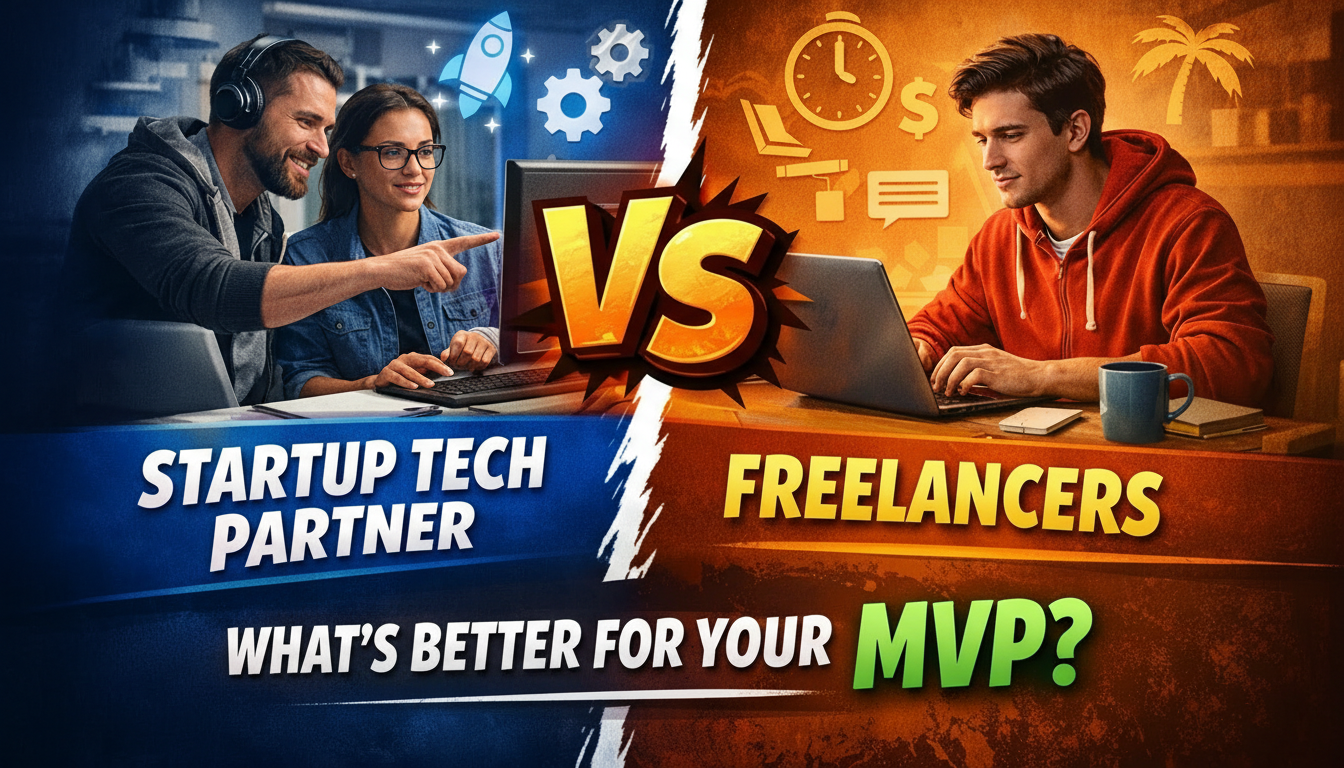
Building a Minimum Viable Product is one of the most critical phases in a startup’s journey. Your MVP is not just a prototype; it is the foundation of your business model, customer validation, and future scalability. One of the earliest and most important decisions founders face is whether to work with a startup tech partner or hire freelancers. This decision directly affects cost, speed, product quality, and long-term growth.
At JetBoosters, a tech and digital solution company focused on startup growth, we frequently advise founders who are confused between these two paths. This article breaks down the differences in depth and helps you determine what is truly better for your MVP.
Understanding the MVP Development Challenge
A Minimum Viable Product is built to test assumptions, validate real market demand, and attract early users or investors while operating under limited time and budget constraints. However, many founders mistakenly assume that MVP development is only about coding a basic version of the product. In reality, an MVP is a strategic business asset that must reflect clear product vision, market positioning, and user value from the very beginning.
Developing a successful MVP involves much more than functional features. It requires thoughtful product strategy to prioritize what truly matters, strong UX decisions to ensure early adopters can easily engage with the product, and a scalable technical architecture that can support future growth. Security, performance, data handling, and potential integrations must also be considered early, as overlooking these elements often results in technical debt, poor user retention, and costly redevelopment once the product gains traction.
Many startups underestimate this complexity and focus primarily on short-term development costs, believing that a cheaper and faster build is sufficient for validation. While this may speed up launch, it can compromise product stability, scalability, and investor confidence. This is where the choice between working with freelancers or partnering with a startup tech partner becomes critical, as it directly influences not only how the MVP is built, but how well it supports the startup’s long-term growth and success.
Who Are Freelancers in MVP Development?
Freelancers are independent professionals who usually specialize in a specific skill such as frontend development, backend development, UI design, or QA testing. Startups often hire freelancers because they appear affordable and flexible at the early stage.
For example, a startup founder may hire one freelancer for UI design, another for backend APIs, and a third for mobile app development. While this seems efficient on paper, coordination, accountability, and consistency can become serious challenges as the product grows.
What Is a Startup Tech Partner?
A startup tech partner is more than a development vendor; it is a strategic collaborator that works closely with founders throughout the entire MVP journey. Our company like JetBoosters takes ownership of the full product lifecycle, starting from idea validation and technical consulting to technology stack selection, system architecture, development, quality assurance, deployment, and continuous optimization after launch. This approach ensures that every technical decision supports the startup’s business objectives, user expectations, and future scalability rather than just meeting short-term functional requirements.
Unlike freelancers who typically focus on completing isolated tasks, a startup tech partner operates as an extension of your internal team. The partner contributes strategic insight, anticipates technical challenges, and aligns execution with growth goals, timelines, and market demands. Many founders searching for startup tech partner solutions are not simply looking for developers to write code; they are seeking long-term stability, accountability, and a trusted technical ally who can support the product as it evolves from MVP to a scalable, investor-ready platform.
Cost Comparison: Freelancers vs Startup Tech Partner
Cost is often the first factor founders consider, so let’s look at a realistic calculation.Assume you need an MVP built in three months.
If you hire freelancers, you may need at least three roles. A UI/UX designer charging $25 per hour for 80 hours will cost around $2,000. A backend developer charging $35 per hour for 300 hours will cost $10,500. A frontend or mobile developer charging $30 per hour for 300 hours will cost $9,000. The total development cost becomes approximately $21,500.
Now consider a startup tech partner. A full MVP package from a company like JetBoosters may cost around $18,000 to $22,000, depending on complexity. While the number looks similar, the difference lies in what you receive. The tech partner cost usually includes project management, architecture planning, QA testing, deployment, and post-launch support, which freelancers often charge separately or do not provide at all.
When founders search for MVP development, they often overlook the hidden costs of delays, rework, and miscommunication that can exceed the initial freelancer savings.
Speed and Time-to-Market Considerations
Freelancers work independently and often juggle multiple clients. This can slow down progress if one freelancer becomes unavailable or misses deadlines. Coordination between multiple freelancers also increases development time, especially when technical dependencies exist.
A startup tech partner operates with an integrated team and a defined delivery process. Tasks run in parallel, blockers are resolved faster, and deadlines are managed professionally. For startups aiming to impress investors or capture early users quickly, faster time-to-market can be more valuable than minor cost savings.
Product Quality and Scalability Impact
MVPs built by freelancers often focus only on immediate functionality. Scalability, security, and maintainability are usually not prioritized unless explicitly requested. This can create major issues when the product gains traction and requires new features or higher user loads.
A tech partner designs the MVP with future growth in mind. Even if the initial version is simple, the architecture is prepared for scaling. This approach significantly reduces technical debt and saves money in later stages.
Founders interested in tech partner collaborations typically benefit from this long-term vision.
Accountability and Risk Management
One of the most significant risks of working with freelancers during MVP development is the heavy dependency on individual contributors. If a freelancer becomes unresponsive, misses deadlines, changes availability, or delivers substandard work, the entire development timeline can be disrupted. Since freelancers often work independently and manage multiple clients, startups have limited control over priorities and delivery consistency. In addition, legal protection, documentation standards, and long-term accountability are usually minimal, making it difficult to manage disputes or recover lost time and investment.
In contrast, a startup tech partner provides a structured and accountable engagement model designed to reduce risk. Accountability is clearly defined through formal contracts, service-level agreements, and transparent communication processes. Work is handled by a dedicated team rather than a single individual, ensuring continuity even if team members change. This team-based approach spreads risk, improves quality control, and provides greater reliability, making a startup tech partner a far safer option for mission-critical MVP development where timelines, product quality, and business credibility are essential.
Strategic Guidance Beyond Code
Freelancers are typically hired to execute clearly defined tasks, such as building a feature or fixing a specific component, based strictly on the instructions they receive. Their responsibility usually ends with code delivery, and they rarely question product assumptions, challenge feature decisions, or consider how individual components align with broader business goals. As a result, critical aspects such as product-market fit, user behavior, and long-term usability may be overlooked, even if the code itself functions correctly.
A startup tech partner, on the other hand, brings strategic perspective along with technical execution. Drawing on experience from working with multiple startups, a tech partner actively contributes insights on feature prioritization, user experience optimization, and alignment between the MVP and market needs. This guidance helps founders avoid overbuilding, focus on what delivers real value, and position the product more effectively for growth. Such strategic involvement can be the deciding factor between an MVP that simply exists and one that attracts users, builds investor confidence, and generates early revenue.
Final Verdict: What’s Better for Your MVP?
If your goal is short-term validation with minimal complexity, freelancers may seem attractive. However, if your MVP is the foundation of a scalable startup, a startup tech partner is almost always the smarter investment. The slightly higher upfront cost is offset by better quality, faster execution, reduced risk, and long-term savings.
At JetBoosters, we specialize in helping startups move from idea to MVP and beyond with a strategic, scalable, and growth-focused approach. If you are serious about building a product that lasts, choosing the right technology partner can be one of the best decisions you make.
People actively searching for startup MVP solutions or tech partner services often find that the right partnership accelerates not just development, but the entire startup journey. Book a Free Consultation Now
Common Question: Startups Ask About MVP Development
Yes, freelancers can be suitable for very simple MVPs, one-page applications, or validation experiments with extremely limited budgets. If your MVP has minimal integrations and no long-term roadmap, freelancers may work.
Most startups realize that managing multiple freelancers becomes inefficient as the product grows. They switch to a tech partner to improve stability, scalability, and coordination once early traction appears.
A good tech partner like JetBoosters offers flexible engagement models while maintaining structure. This gives startups both agility and reliability, which freelancers alone often cannot provide.
Investors look for scalable products, clean architecture, and professional execution. MVPs built with a startup tech partner generally meet these expectations better than fragmented freelancer-built products.